
· 4 min read
The Guessing Game in Pipeline Inspection
Lightweight 3D defect sizing on edge hardware.
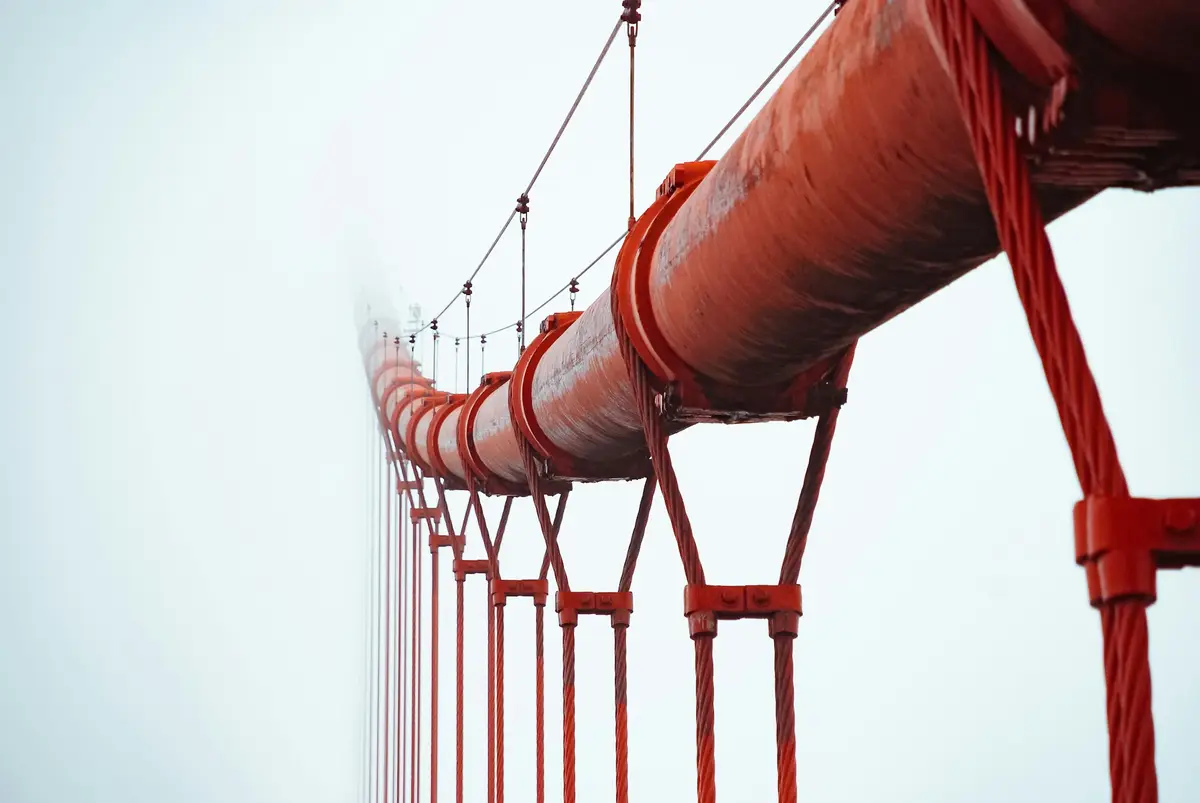
Underground steel pipelines operate under brutal conditions. Thousands of miles of high-pressure infrastructure run under riverbeds, farmland, and highways, carrying volatile fluids at hundreds of pounds per square inch. A single undetected structural flaw leads directly to a catastrophic rupture.
Finding those defects depends on running an autonomous inspection tool through the line. Known in the energy sector as a smart pig, this heavy steel cylinder travels through the pipe driven by fluid pressure, sweeping the metal walls with high-density Magnetic Flux Leakage sensors.
As magnetic fields pass through healthy steel, the flux lines stay contained within the wall. When the field hits an area of metal loss, the magnetic flux leaks out into the air cavity, where Hall-effect sensors log the distortion across three physical axes.
The engineering challenge starts right after signal capture. Reading a magnetic spike tells you a defect exists, but it does not tell you how deep it goes. Turning noisy 3-axis magnetic distortion data into an accurate 3D volumetric profile is a severe mathematical inverse problem.
Miscalculating a defect's depth by a couple of millimeters creates two expensive failure modes. Overestimating the flaw forces an energy company to mobilize heavy machinery, dig up ten feet of highway, and cut out a perfectly safe pipe segment. A single unnecessary excavation regularly burns over $100,000 in operational overhead. Underestimating the flaw leaves a compromised wall segment in service under high pressure, setting up a catastrophic line blowout.
Traditional deep learning models struggle here. Training a standard convolutional neural network to map 3D defect geometry requires vast amounts of labeled real-world failure data. Pipeline operators simply do not have 100,000 real-world pipe bursts sitting in a clean dataset.
A paper published in Results in Engineering presents a far cleaner approach based on an advanced multi-branch online knowledge distillation architecture. Instead of relying on brute-force training sets, the system splits 3-axis magnetic streams across specialized, parallel feature extraction branches that teach each other in real time, delivering high-precision 3D defect sizing directly on low-power edge hardware.
Multi-branch distillation and physical feature extraction
Processing 3-axis magnetic flux signals in a steel pipe is an exercise in managing high-dimensional noise. Hall-effect sensor arrays record magnetic density changes across radial, axial, and circumferential dimensions. Ambient electromagnetic interference, minor sensor jitter, and minor variations in pipe wall thickness distort those signals, producing irregular voltage curves that confuse standard single-pipeline neural networks.
The multi-branch architecture addresses this by decoupling the signal into distinct physical feature channels before classification. Instead of feeding an uncompressed, 3-axis matrix into a single heavy model, the framework routes individual axial components to dedicated feature extraction branches. The radial branch focuses specifically on amplitude spikes that dictate defect depth. The axial and circumferential branches isolate signal pulse width, defining the physical boundary lengths and horizontal footprint of the defect.
Standard knowledge distillation relies on a massive, pre-trained teacher model transferring knowledge downstream to a lightweight student model. That approach breaks down in pipeline inspection because an ultra-accurate teacher model cannot be trained without massive real-world datasets. This architecture uses online distillation, running multiple compact student networks in parallel and forcing them to evaluate and refine each other's feature maps mid-run.
Each branch acts as both student and teacher simultaneously. By continuously sharing loss metrics across the network during training, the parallel branches reach mutual convergence without requiring a massive teacher network. This cross-branch feedback loop forces the system to learn the underlying mathematical relationship between physical metal loss and magnetic field distortion, filtering out transient sensor noise while retaining exact structural proportions.
The adaptive fusion layer and edge execution
Parallel feature branches isolate raw signals, but converting those streams into an accurate 3D volumetric profile requires dynamic weighting. Sensor channels do not contribute equally across different flaw profiles. Broad surface pitting triggers high circumferential variation with minimal radial movement, while a narrow gouge presents the opposite pattern.
An adaptive fusion subnet resolves this by calculating real-time spatial weight coefficients for each feature map based on local signal-to-noise ratios. Through dynamic channel attention, the subnet amplifies high-confidence radial vectors during steep amplitude spikes while suppressing background noise and sensor wobble from adjacent channels.
Deploying this architecture to embedded hardware hits strict operational limits. Smart pigs run on internal battery power with zero cloud connectivity while traveling through high-pressure steel lines. Onboard processors cannot run monolithic networks without thermal throttling or draining onboard power.
Decoupling feature extraction across lightweight student branches drops the parameter count substantially. The compressed model runs deterministic inference on low-power edge chips, outputting precise 3D defect dimensions in milliseconds before the inspection tool hits the recovery trap.
The future of pipeline integrity and edge intelligence
Relying on brute-force model size and massive training sets to solve industrial sensor problems is a dead end. Collecting hundreds of thousands of physical pipe failure samples remains practically impossible, and hauling heavy compute infrastructure through miles of buried steel is an operational non-starter.
This multi-branch online knowledge distillation architecture provides a clear path forward. By embedding physical domain knowledge into parallel network structures, the system extracts high-precision 3D defect profiles without relying on bloated models or unachievable data volumes.
These principles extend far beyond oil and gas lines. As autonomous drones, subsea crawlers, and industrial robotics take over critical maintenance across energy grids and transportation networks, the processing bottleneck will always sit at the physical edge. Algorithmic distillation paired with adaptive feature fusion proves that lightweight, structured architectures can replace raw compute force, cutting operational maintenance costs while catching structural flaws before they fail.